Updated Mar 10, 2026

Stridewise
Boots, Denim and Casual Stuff
In twenty-three years of wearing work boots, I’ve never owned a pair from Georgia Boot, so I was excited to give their budget soft-toe Georgia Giant Waterproof High Romeo (GR500) a go.
Georgia Boot positions itself as a budget-friendly brand, with its most expensive models topping out around $260. For comparison, I typically wear pricier Red Wings, Thorogoods, and Danners, while the Romeo GR500 retails for only $140 — but can it deliver real value at that price?
I’ll evaluate the boot based on my usual criteria: construction and durability, comfort, and fit. I’ll also cover safety, though it won’t receive a rating. Let’s dig in.

They’re lightweight, waterproof, Goodyear welted, and include extra stitching at the toebox for added durability.
This boot is slip resistant, waterproof, lightweight, shock absorbent, and gave me no break in difficulties.
But it’s not breathable, the plastic welt makes it hard to resole, the lining tore after a week of wear, and it has no ASTM ratings except for the steel toe. I think you’re better off with Wolverine’s (usually cheaper) Romeo Boot.
Construction & Durability: 2.5/5
Sizing & Fit: 5/5
Weight: 5/5
Cost: 5/5
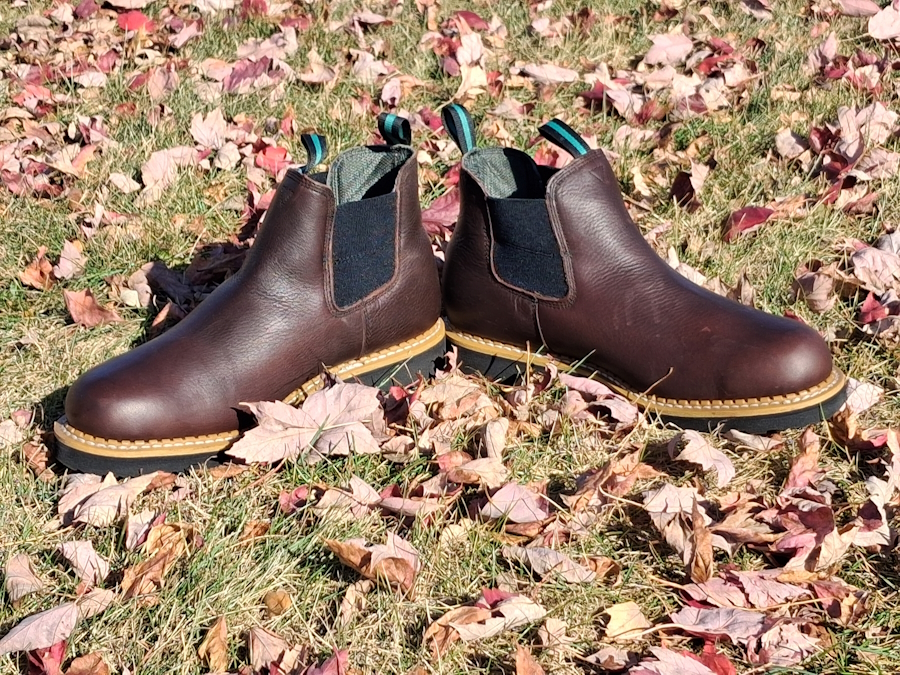
They’re lightweight, waterproof, Goodyear welted, and include extra stitching at the toebox for added durability.
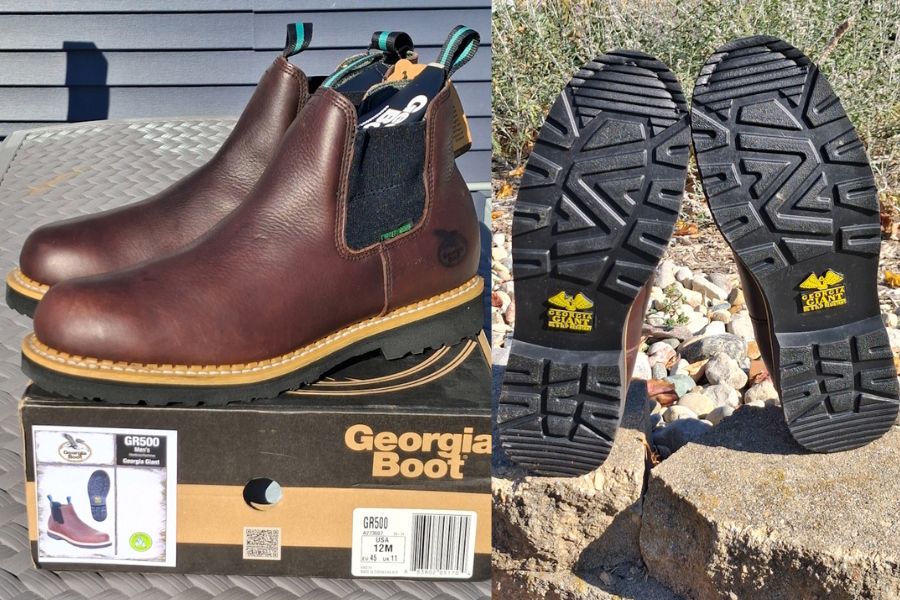
My job as a water plant operator requires several miles of walking each day across a wide range of surfaces, including concrete, tile, metal, grass, dirt, and even snow in winter.
I also wore the Romeo GR500s off the clock: I spent six consecutive days wearing them for all of my daily activities: walking, running errands, playing with my kids, and working outdoors. Why only six days? We’ll get to that later.
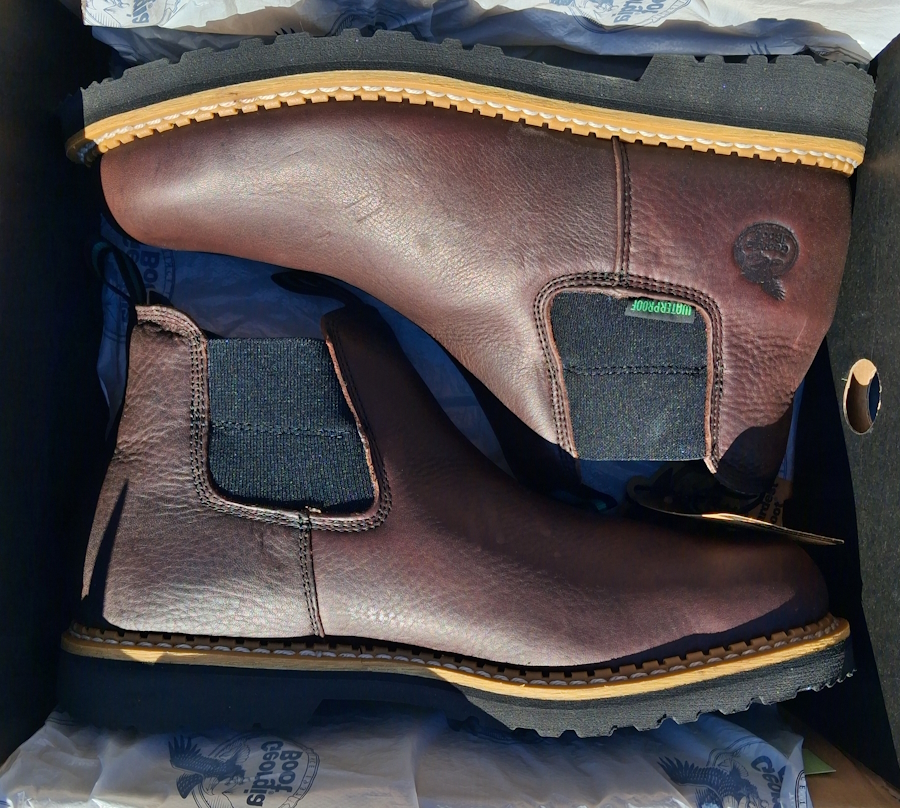
| Safety Toe | No |
| Slip Resistant | Yes – not rated |
| Electric Hazard Rated | No |
| Waterproof | Yes, Georgia Waterproof System |
| Construction | Goodyear Welt |
| Midsole | EVA |
| Outsole | Oil-resistant polyurethane outsole |
| Shank | Steel |
| Height | 4 inches |
| Country of Origin | Dominican Republic |
| Variants | GR530 (Steel Toe) |
| Sizes Available | US Men’s Full 7–14, Half 7.5–11.5 |
The company was founded in 1937 and acquired by Rocky Brands in 2004, yet there’s surprisingly little about its history on the official website.
It’s worth emphasizing, though, that some people believe Georgia Boot make all their boots in the USA, but they don’t. Allamerican.org found that four models are made in the USA (with imported components) but the vast majority of them are made overseas.
My Romeo Chelseas are made in the Dominican Republic, which I was actually glad to see, because if they were this price and made in the USA? Well, there’s not much chance that they’d be very good!
Goodyear welt construction is considered the “gold standard” for a resoleable boot, and while you can debate the ins and outs of different kinds of resoleable boots, it’s fair to say that it’s the standard: if there’s one kind of boot a cobbler can resole (and that’s often the case), it’ a Goodyear welt.
However, the welt is usually leather. In cheaper boots like this one, the welt is plastic. This means the sole is still unlikely to delaminate or let water into the boot, but it’s a lot harder for a cobbler to resole it.
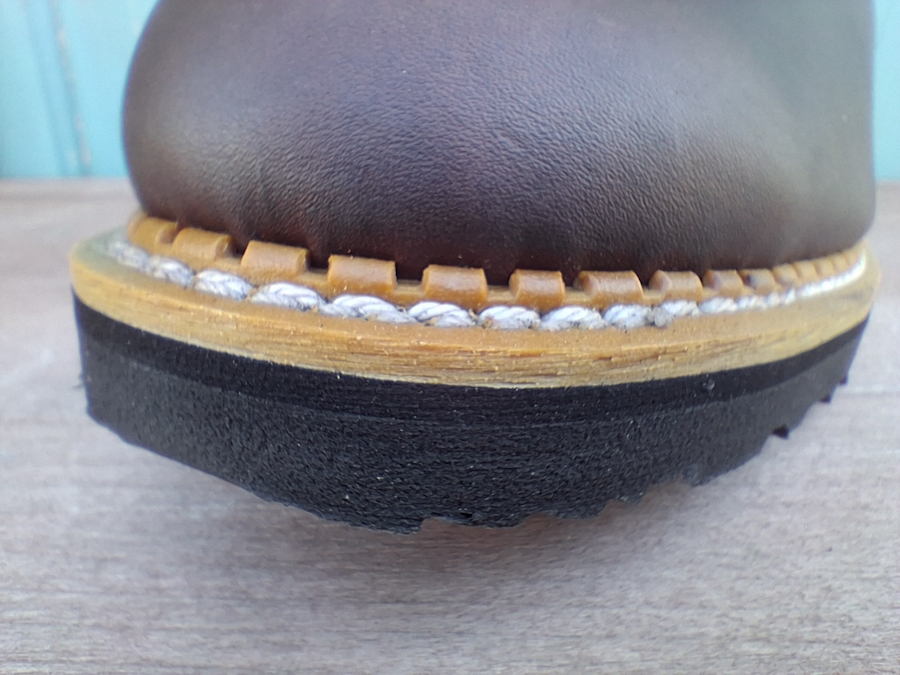
You might get one resole, or he might want to replace the welt. In any case, it’s not quite the same value proposition as your standard Goodyear welt — but hey, it’s a $140 boot.
There’s also an additional stitch at the front to help prevent separation between the outsole and midsole. Because I frequently work around chemicals, a slip and chemical-resistant outsole is a necessity for me.
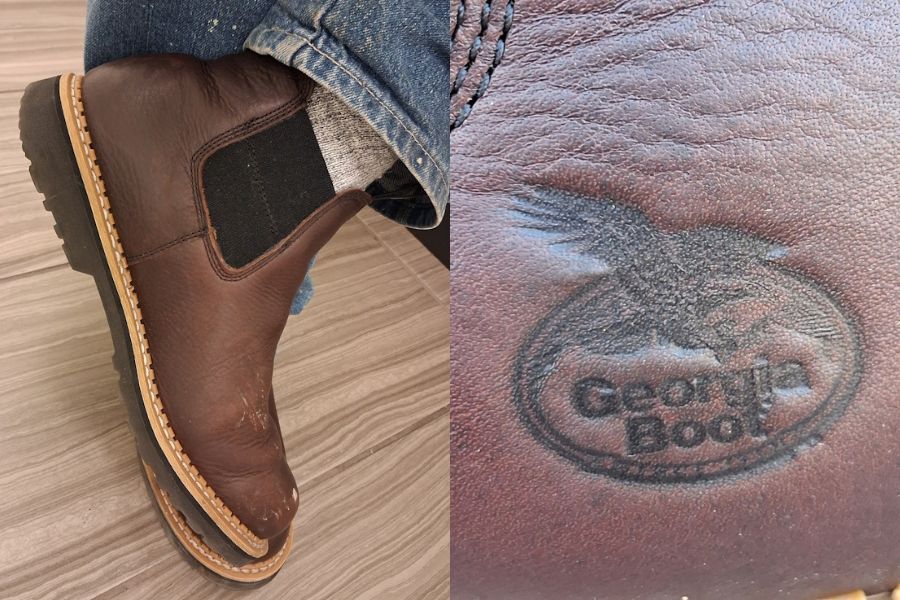
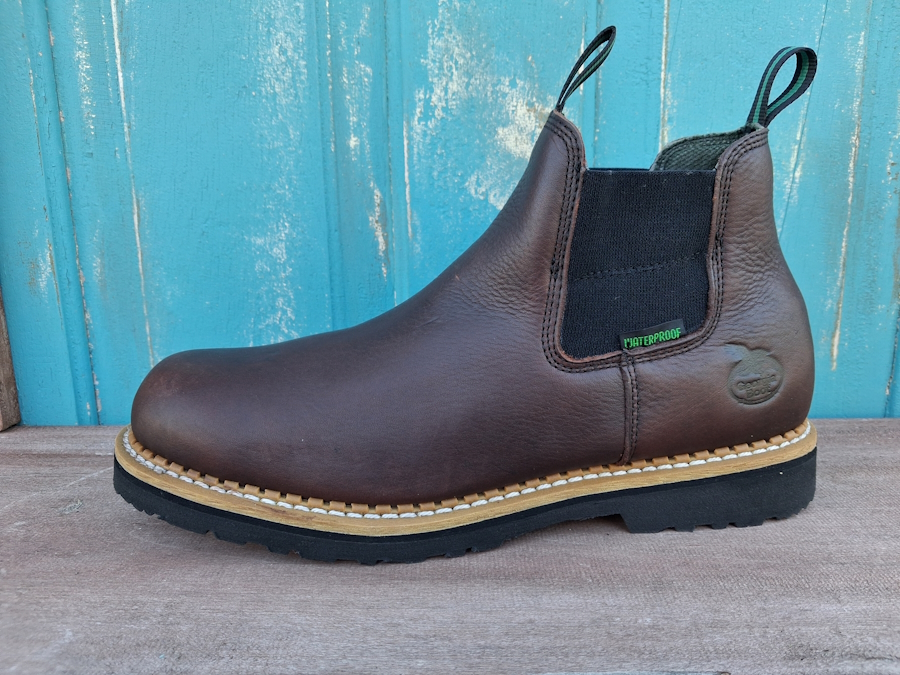
The simple design uses just three panels of full-grain leather. It’s soft, pliable, and water-resistant. I measured the leather at 1–1.5 mm thick, which is about 1 mm thinner than Redback, a competitor I’ve tested previously.
When I asked Georgia Boot where the leather was sourced, they told me they were unable to provide that information. That’s pretty par for the course for boots at this pricepoint.
Each boot has elastic goring and two pull tabs secured with triangular stitching to assist with pulling them on and off.
The waterproof lining extends about halfway up the goring. I’m pretty happy with that, since a lot of similar boots don’t waterproof the goring at all.
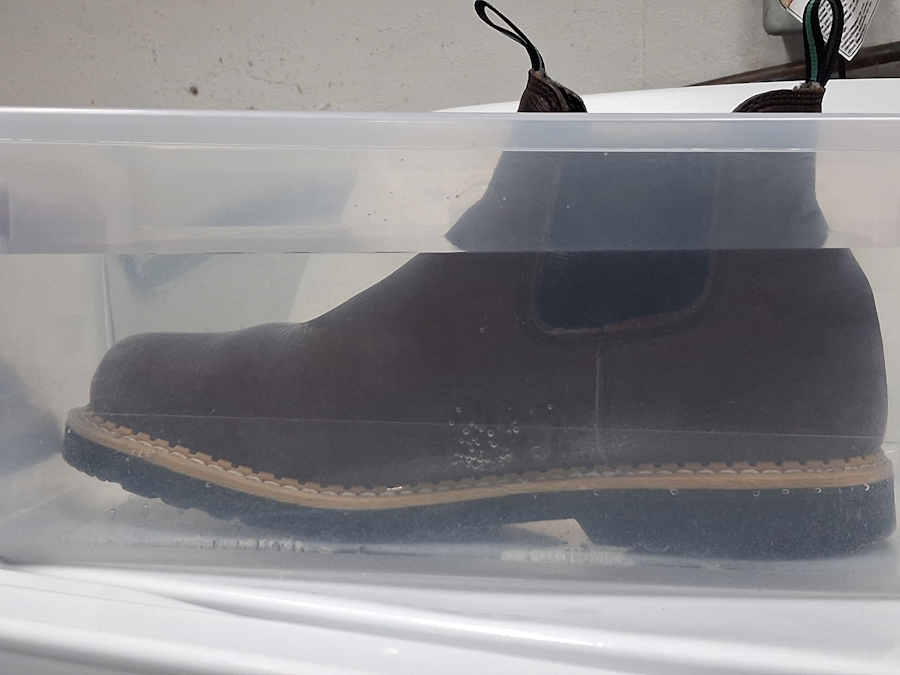
The boots use a mesh liner backed with foam, which houses the Georgia Waterproof system. According to the company, it “keeps water out while letting air in. Your feet stay dry, guaranteed.”
I performed a five-minute submersion test, immersing the boots up to the midpoint of the goring — about 4.7 inches — and the system performed as advertised. My feet stayed completely dry.
That said, they’re wrong about the “letting air in” part. By the end of an eight-hour shift, my feet felt uncomfortably warm, regardless of whether I wore cotton or wool socks. These boots are noticeably less breathable than the Gore-Tex–lined boots in my rotation.
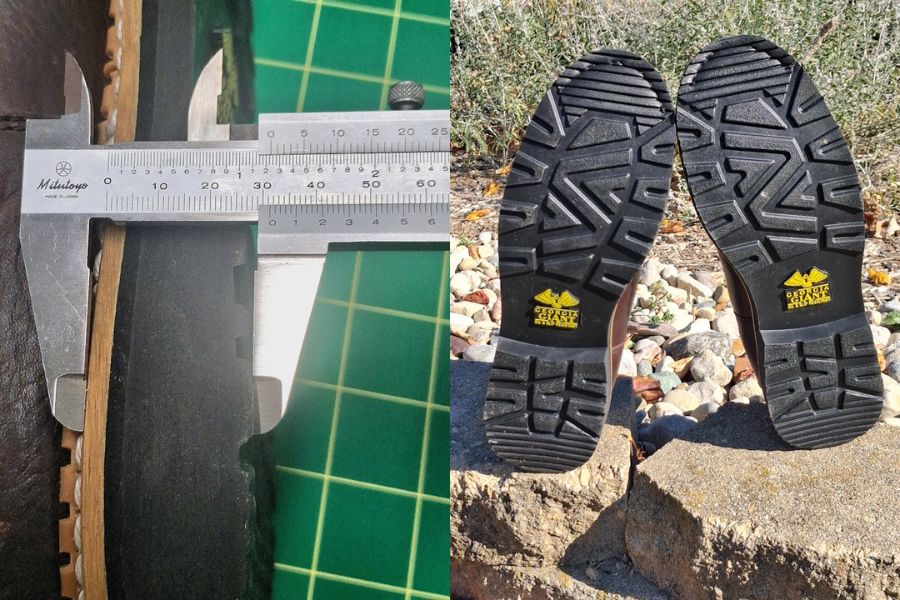
The “Giant” name refers to the oversized outsole. It’s made from polyurethane and is both oil- and slip-resistant. As mentioned, it’s glued to the midsole rather than stitched — not an unreasonable design feature at this pricepoint.
The shallow tread pattern measures 0.15” deep, which helps reduce tracking of snow and mud. The heel depth is 0.5”, giving the boot more of a wedge-sole feel underfoot.
The midsole is made from EVA (ethylene-vinyl acetate), a lightweight foam material. It’s glued to the outsole and attached to the upper.
These boots use a steel shank, which helps distribute weight and improve stability on ladders and uneven surfaces like rocks. Running from the heel to the midfoot, the main point of a shank is to keep the boot’s heel and forefoot from moving independently of one another, as this is a common cause of sore feet.
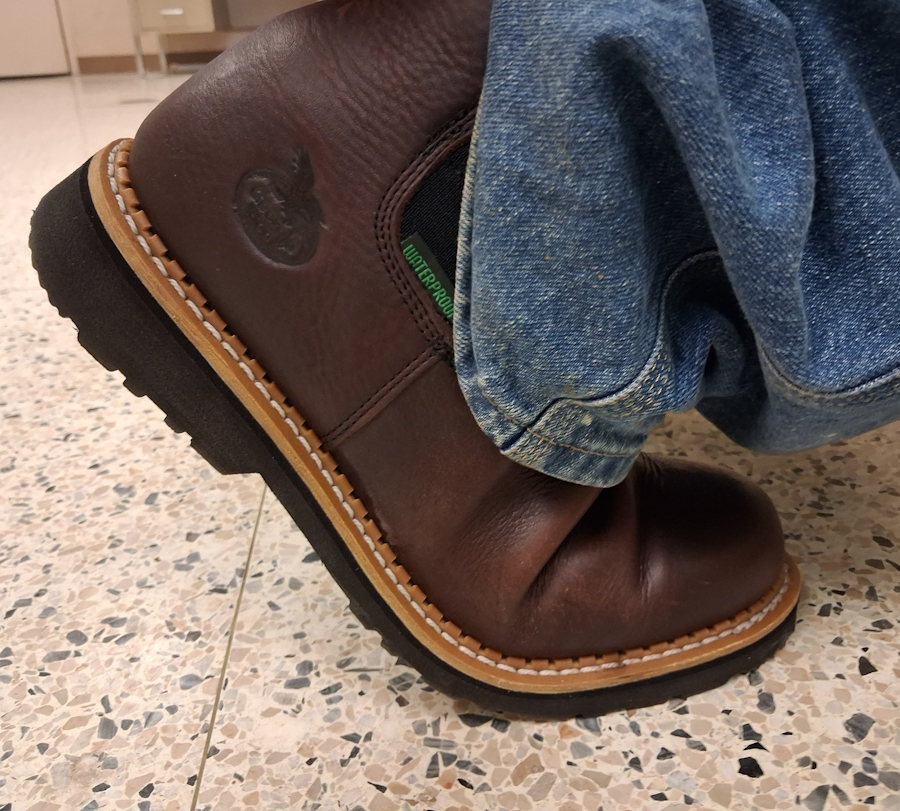
I wear a 12D in Red Wing’s work boots and a 12EE in Thorogood mocs, and the GR500s fit very similarly. In other words, they fit true to size: while you usually have to size down for Goodyear welted boots, it wasn’t the case here. Go get measured on a Brannock device at a shoe store, and simply order that size from Georgia Boot.
If possible, I recommend trying them on in person at a local store to confirm sizing before purchasing.
These are the only safety-related elements on the GR500. If you need protective toe coverage, the steel toe version, the GR530, meets ASTM F2413 standards.
Rating: 5/5
Sales are common, so it’s worth keeping an eye out — while writing this review, the GR500 was on sale on Amazon.
They’re lightweight, waterproof, Goodyear welted, and include extra stitching at the toebox for added durability.
For comparison, Wolverine offers a similar style, the I-90 EPX Romeo, for $155 on their site — but at the time of writing, it’s $140 on Amazon.
I don’t feel comfortable recommending the GR500.
On paper, these boots have a lot going for them: they’re lightweight, waterproof, Goodyear welted, and include extra stitching at the toebox for added durability. They look good, and they’re priced lower than many competing brands.
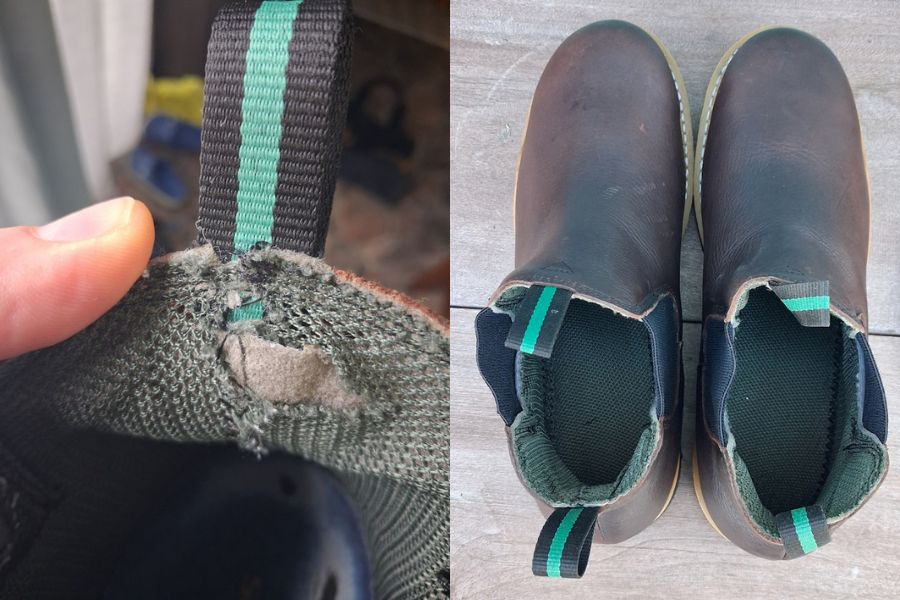
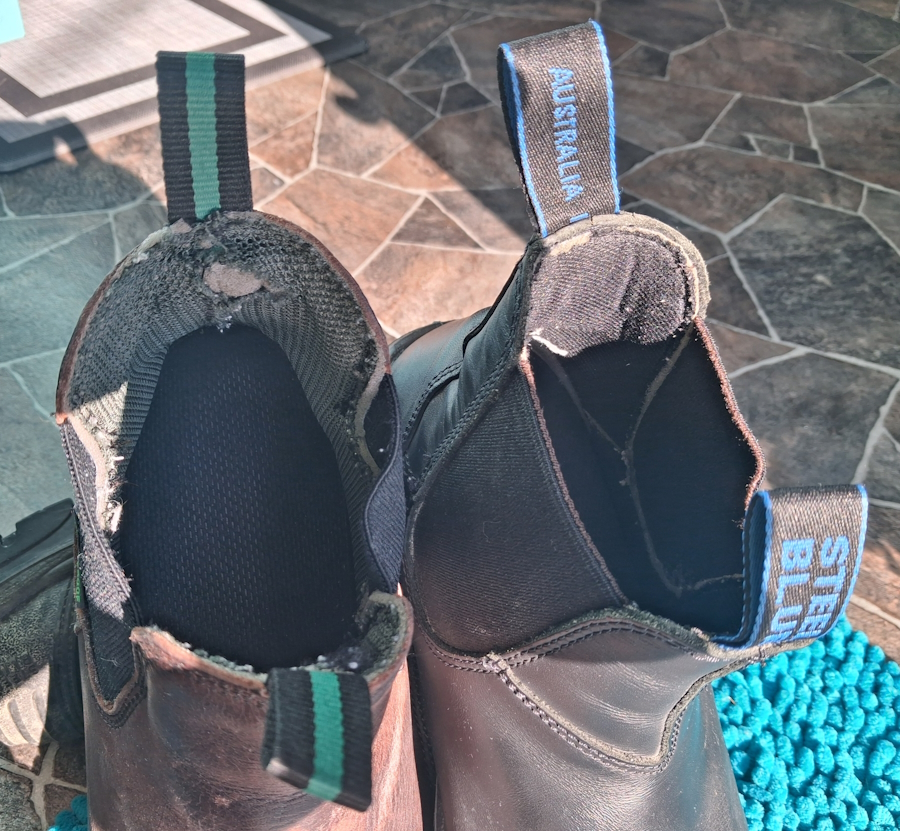
However, after just six days of wear, the mesh at the heel of the throat ripped. That alone told me what I needed to know, but they’re also not breathable at all. I wouldn’t normally knock a waterproof boot for feeling stuffy, but Georgia Boot claim that the GR500 is perfectly breathable, and it isn’t.
For context, my Steel Blue Chelsea boots, which I’ve worn for over a year, have interior materials that have held up far better than the GR500’s mesh — but to be fair, they cost some $60 more than the GR500s.
With all that said, you may still want to try the GR500 for yourself. Georgia Boot does offer a warranty, and it’s possible I received an unusually weak pair.
Thank you for taking the time to read this review. I hope you found it helpful and informative.

Jeff is a Level III water plant operator with 20+ years of experience who thoroughly enjoys boots and hot sauce. Up until the last year or so, boots were just a requirement for work. His new love for boots has made him more appreciative of the craftsmanship that goes into making them. He is very passionate about reviewing boots and trying to help others find what would work best in their work or casual wear.

by Nick English
Founded in 2018 to help men buy the best boots, we’ve since expanded our team and purview to review and celebrate casual footwear and menswear that’s as close to “buy it for life” quality as possible. We take great pride in being a trusted source for information while maintaining complete editorial independence. At no extra cost to you, we might earn a commission from a brand when you purchase through our links, which helps us keep our mission alive. Learn More
Casual Durable™.
Yup, we even trademarked it. Just because you’re dressed down, doesn’t mean you have to dress bad.
This site started to help guys find the best boots for their dollar and has since expanded to cover the highest quality casual menswear, from leather jackets to selvedge jeans to canvas bags — the kind of simple, fashionproof classics that help you get dressed without overthinking your “style.” Read more
Subscribe for an exclusive article to help you find the best deals on quality footwear.